WENZHOU, ZHEJIANG, CHINA, April 15, 2026 /EINPresswire.com/ — Traditional automation delivers speed and precision — but at the cost of inflexibility. In an era of high-mix, low-volume production, reprogramming caged robots for every changeover is a non-starter.
Collaborative robots — or cobots — were built for this new reality. Designed for safe, direct interaction with people, they bridge the gap between the precision of industrial robots and the adaptability of human workers. Not merely tools, they are intelligent partners that solve the core bottlenecks of flexible manufacturing.
The Core Problems: Where Traditional Automation Falls Short
Manufacturers today face a triad of challenges that rigid, caged robots cannot solve. At KeyGree, they will encounter these pain points directly when consulting with clients on their factory floor strategy, whether they are integrating a single SCARA cell or a full production line with tracks and positioners.
1. The High-Mix, Low-Volume Bottleneck
Markets demand customization — smaller batches, greater variety. Traditional automation requires costly, time-consuming reprogramming and re-tooling for each changeover. For SMEs, dedicated automation lines are often cost-prohibitive.
2. The Skilled Labor Gap
Repetitive, strenuous tasks — assembly, polishing, machine tending — lead to fatigue, injury, and turnover. These “dull, dirty, and dangerous” jobs fail to utilize skilled workers’ full potential, and qualified labor is increasingly hard to find.
3. The Rigidity of Fixed Automation
A conveyor line optimized for one product is obsolete for the next. Adapting traditional systems to new products is a major capital project — stifling innovation and responsiveness.
The Cobot Solution: How It Works and Why It’s Different
Cobots resolve these issues through a combination of inherent safety, ease of use, and advanced sensing. KeyGree integrates these core principles across its automation portfolio, ensuring that whether a customer deploys a standalone collaborative arm or one synchronized with linear tracks, the fundamental benefits of flexibility and user-friendliness are preserved.
1. Safe Collaboration as a Foundation
Unlike their industrial counterparts, cobots are built with power- and force-limiting designs, rounded edges, and no pinch points. They operate without safety cages, sharing workspace with humans. International safety standards (ISO 10218) define four types of collaboration, with Power and Force Limiting (PFL) being the most common, where the robot senses collision and stops immediately.
2. Intuitive Programming and Rapid Deployment
The biggest barrier to automation—complex programming—is eliminated. Most cobots feature hand-guiding or drag-and-drop programming, where a worker physically moves the arm through a task, which the robot memorizes. This allows line operators, not robotics engineers, to deploy and redeploy the robot in hours, not weeks. For example, a cobot can be taught a new pick-and-place path in minutes when a production line switches components.
3. Force Control and Adaptive Precision
This is where cobots transition from simple movers to skilled “workers.” Force-torque sensors in the robot’s joints or wrist allow it to “feel” its environment. In an assembly task, instead of blindly pushing a gear onto a shaft (risking damage), a force-controlled cobot can apply precise pressure, sense misalignment, and perform a spiral search to find the correct position, dramatically improving success rates for tasks with inherent tolerances.
4. Vision and Multi-Modal Perception
Equipped with vision systems, cobots gain situational awareness. They can identify randomly oriented parts, perform quality inspections, and adjust their actions in real-time. This multi-modal perception, combining vision with force control, is key to handling the variability and complexity that defines modern manufacturing. It is this seamless integration of perception, action, and control that KeyGree leverages when designing a complete work cell, ensuring the cobot, the vision system, and any peripheral automation like Delta robots work in perfect concert.
Selecting the Right Cobot: Reach and Payload Matter
Not all cobots are created equal. Two parameters determine fit for your application: reach (working envelope) and payload (carrying capacity).
The range shown below — 620–1800mm reach, 3–30kg payload — covers the vast majority of industrial tasks, from small-part assembly to heavy machine tending.
Transformative Applications Across Industries
Cobots have moved beyond simple pick-and-place into core manufacturing processes. KeyGree’s role is to provide not just the robot, but the complete, optimized application package.
Precision Assembly with Force Control: In automotive or electronics, cobots perform delicate insertions (like connector pins), screw-driving with torque feedback, and wire harnessing. A case study from Rokae shows cobots using force-controlled search to insert HDMI cables into televisions with ±0.1mm tolerance, achieving a 12-second cycle time and adapting to multiple TV models. This mirrors the application-specific expertise KeyGree brings, ensuring the cobot, tooling, and control logic are perfectly tuned.
Quality Inspection and Finishing: Equipped with vision cameras and tools, cobots automate visual inspection for defects and consistent surface finishing like polishing, sanding, or deburring. Their force control ensures even pressure on curved surfaces, a task extremely difficult to program on a traditional robot. Here, KeyGree’s ability to supply both the collaborative robot and the appropriate finishing end-effector as a validated package drastically reduces integration risk and time-to-production.
Machine Tending & Flexible Welding
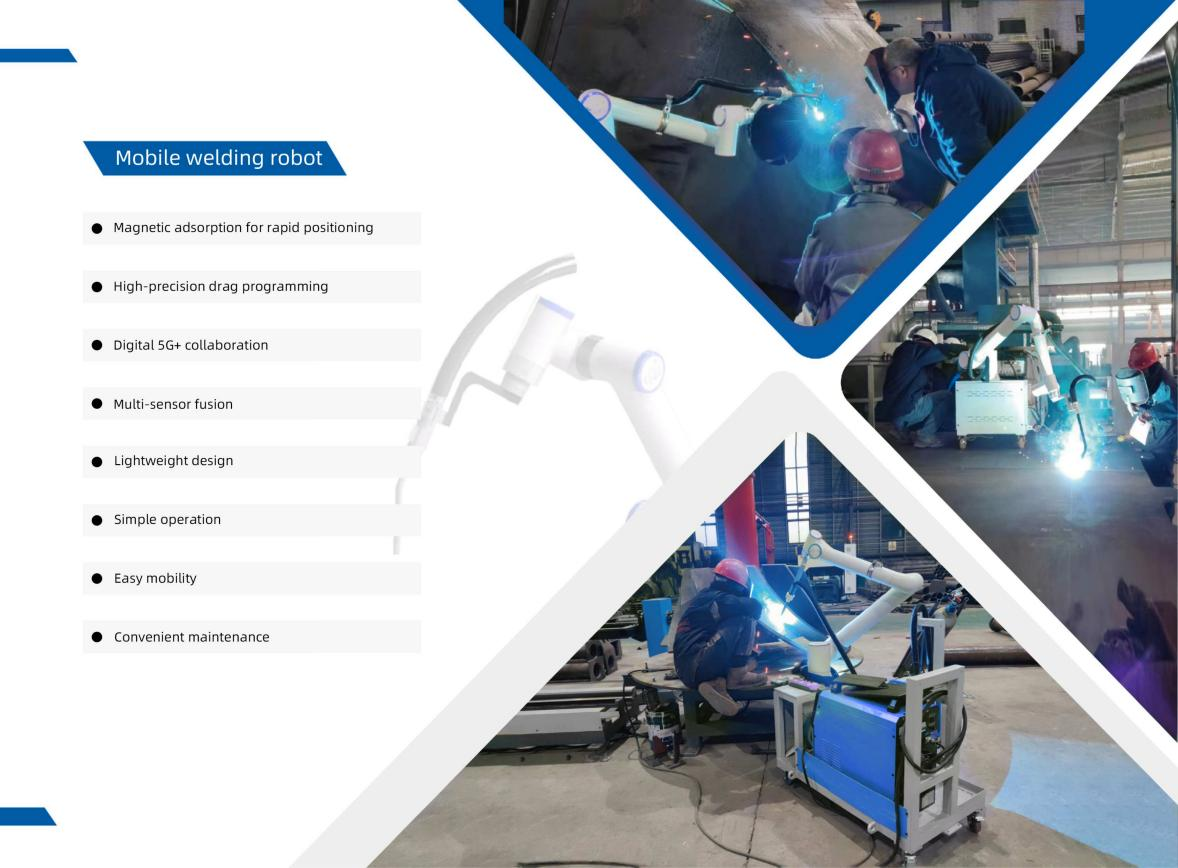
Cobots excel at loading/unloading CNC machines, injection molders, and stamping presses — tasks that tie up skilled operators. In welding, they enable automated, high-quality results for small batches that would never justify traditional robotic cells.
This is where KeyGree’s full-stack capability matters: we don’t just supply the cobot. We integrate it with the welding power source (e.g., MIG300DP), a coordinated servo turntable or linear track, and application-specific tooling — delivering a production-ready welding cell, not a collection of parts.
The Mobile Cobot: Mounting a cobot on an autonomous mobile platform (AMP) breaks the “fixed station” paradigm. This “cobot-on-a-cart” can move between different machines or workstations, performing tending, inspection, or delivery tasks on-demand, creating a new level of flexible automation. KeyGree views this as the next frontier of integrated automation, where mobile robotics solutions converge with collaborative and SCARA robot technologies to create dynamic, reconfigurable factory floors.
The Future: From Tools to Intelligent Partners
The frontier of cobotics is “embodied AI” and multi-robot collaboration. Systems are evolving to integrate cobots with mobile robots, AI, and vast sensor networks to create centrally coordinated, flexible production units. Furthermore, integration with large language models (LLMs) is paving the way for natural language instruction, where a worker can simply tell the robot what to do. KeyGree is actively investing in this intelligent ecosystem, ensuring diverse portfolio—from the nimble Delta to the powerful cobot—can communicate and collaborate not just with humans, but with each other, governed by advanced fleet management and AI-driven optimization software.
The collaborative robot is the definitive answer to modern manufacturing’s demand for agility. It solves the triad of challenges — flexibility, skilled labor dependency, and high-mix production — not by replacing humans, but by amplifying their capabilities.
For KeyGree, cobots are the intelligent, adaptable heart of a broader automation ecosystem. As they evolve from programmable arms into perceptive, learning partners — integrated with mobile platforms, vision systems, and AI — they will dissolve the remaining barriers between human creativity and automated execution. The factory of the future is not human-less; it is human-enabled, with cobots at the core.
Keygree Group Co., Ltd.
Keygree Group Co., Ltd.
+86 18058395375
info@keygree.com
Legal Disclaimer:
EIN Presswire provides this news content “as is” without warranty of any kind. We do not accept any responsibility or liability
for the accuracy, content, images, videos, licenses, completeness, legality, or reliability of the information contained in this
article. If you have any complaints or copyright issues related to this article, kindly contact the author above.

Media gallery