SHENZHEN, CHINA, November 23, 2026 /EINPresswire.com/ — On November 21, 2026, commercial hardware brand MWE published its Shared Touch Table Acceptance Protocol, outlining an operational checklist for horizontal touch surfaces deployed in shared spaces. The protocol establishes a technical verification framework for dual-sided task execution, multi-angle interface legibility, and application state recovery following interruptions. The release constitutes an unexecuted manual acceptance protocol; its seven defined checkpoints have not been tested on physical hardware or target applications, and the document introduces no empirical test results.
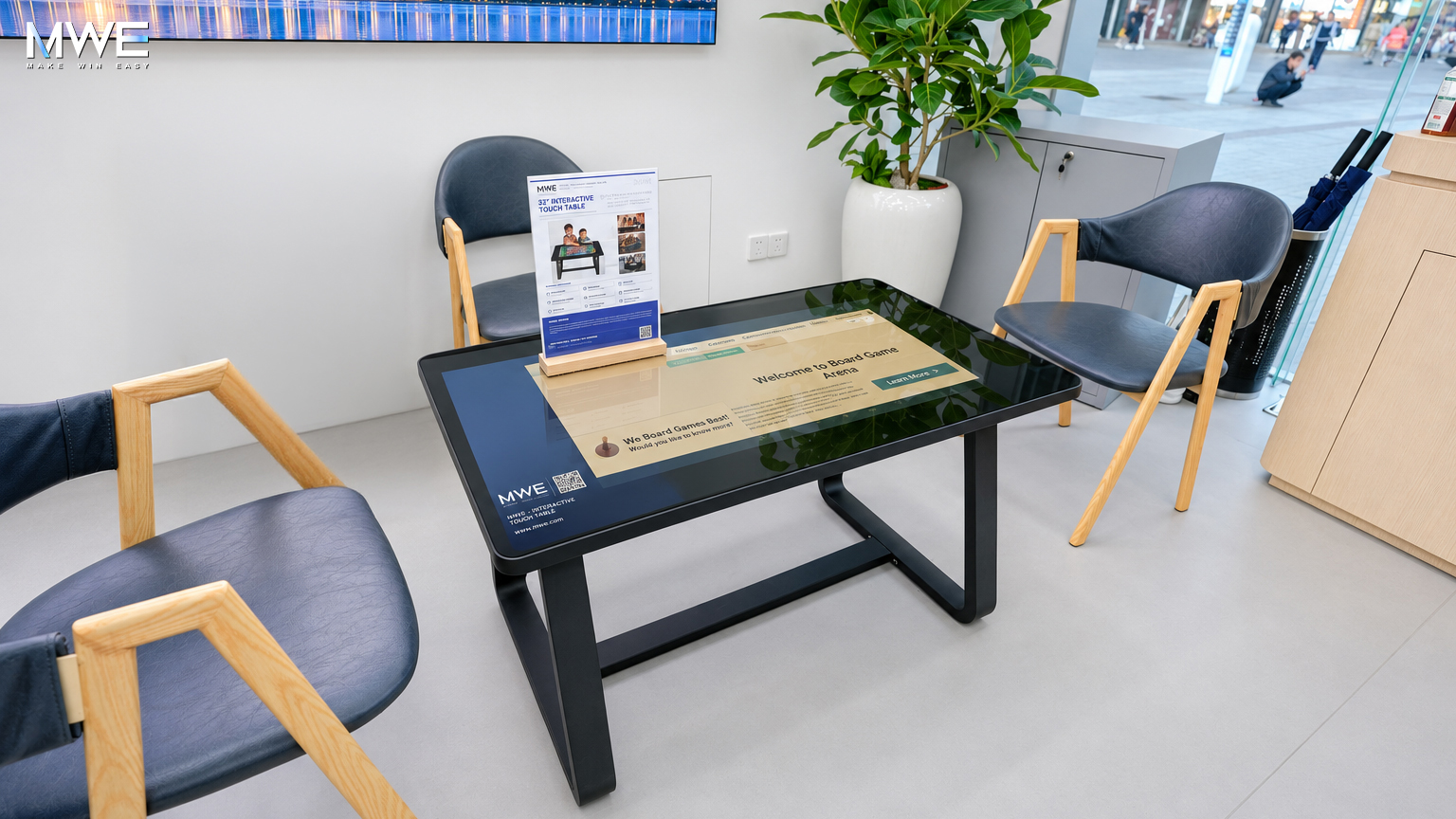
The framework follows a prior display of the MWE 32 Inch Game Table at the CEC SmartHub showroom in Huaqiangbei, Shenzhen, held ahead of the November 2026 Asia-Pacific Economic Cooperation (APEC) gathering. During that showroom presentation, the horizontal unit displayed a board-game website homepage to exhibit panel form factor and physical clearances in an indoor room. The display served as a visual demonstration of the physical furniture envelope rather than an interactive benchmark or certification of live multi-user network operations.
MWE operates as a commercial hardware brand of Marvel Tech Group. According to published manufacturer specifications for the MWE 32 Inch Game Table, the hardware configuration incorporates a 32-inch Full HD multi-point touch display running Android 13, accompanied by 8 GB of RAM and 128 GB of internal storage. The listed physical enclosure measures 39.37 by 22.83 inches with a tabletop height of 21.64 inches, rounded corner framing, a detachable display housing, and a structural load rating of up to 150 pounds. Onboard connectivity options include integrated Wi-Fi and Bluetooth modules.
While hardware parameters define physical footprints and baseline computing specifications, multi-user deployments require pre-installation verification. MWE’s November 21 protocol identifies three core evaluation categories across seven manual checkpoints:
First, concurrent input and task coordination must be verified against specific application design. Across a fixed application version and baseline initial state, the protocol outlines running designated Task A and Task B workflows individually by a single user, followed by concurrent dual-sided execution. Observers record input responsiveness, touch focus, and whether application states maintain expected separation or planned shared states, determining validity based on application functional requirements rather than treating shared state as an inherent defect.
Second, interface legibility requires verification from multiple seated angles. Because the 21.64-inch table height alters standard vertical sightlines, operating teams must confirm whether application assets, fonts, and interactive elements rotate or present sufficient visual clarity for participants viewing the display from opposite directions.
Third, post-interruption task recovery and input state handling require verification grounded in event logs. The protocol specifies checking whether the target application clears pending states, accepts re-input, and resumes workflows following logged native pointercancel or pointerup events. Routine departures or window switches do not guarantee that a pointercancel event fires, and if native cancel events are not captured in the event log, that verification item remains recorded as untested rather than assumed.
For enterprise fleet administration, Marvel Tech Group maintains central scheduling and publishing capabilities across supported connected display networks via the MWE CMS platform: https://news.marveltechgroup.com/systems/cms/. This ecosystem software capability is limited to compatible network environments and configurations, and specific integration between the MWE CMS platform and this 32-inch table SKU or software build has not been verified.
Prospective facility operators are advised to complete independent network latency assessments, administrative permission reviews, and physical cable routing audits before commissioning units for public or institutional access.
Celia Liang
Marvel Tech Group Co., Ltd.
+86 15679783403
Legal Disclaimer:
EIN Presswire provides this news content “as is” without warranty of any kind. We do not accept any responsibility or liability
for the accuracy, content, images, videos, licenses, completeness, legality, or reliability of the information contained in this
article. If you have any complaints or copyright issues related to this article, kindly contact the author above.

Media gallery