JIANGMEN, GUANGDONG, CHINA, August 6, 2026 /EINPresswire.com/ — 80% of first-time cookware importers report quality issues on their first order — wrong steel grades, delaminating bases, handles that loosen within a month. Finding a stainless steel cookware manufacturer or supplier is about more than beating the lowest price on an Alibaba listing; a single bad batch can cost you retail contracts, brand reputation, and months of market momentum.
This guide covers steel grades, base construction technologies, factory verification, and market-specific requirements, plus a practical scorecard for evaluating any manufacturer.
Key Takeaways
· The global stainless steel cookware market exceeds $8.5 billion and is growing 4–6% annually — demand isn’t the challenge, supplier quality is.
· 304 (18/8) stainless steel is the minimum standard for food-contact cookware; 201 steel is unsuitable and frequently misrepresented.
· Base construction technology (Whole-Clad vs. Impact Bonding vs. Brazing) significantly affects performance, price, and market fit.
· Nesting/Matryoshka sets and colorful painted exteriors are differentiated, cost-efficient product lines with strong urban and Gulf-market appeal.
· A factory evaluation scorecard can eliminate 90% of sourcing risk before your first order.
Why Stainless Steel Cookware Dominates the Global Market
The global market was valued at roughly $8.69 billion in 2024, projected to reach $12.46 billion by 2030 at a ~6% CAGR (Grand View Research), with stainless pots and pans making up over 41% of category revenue. Growth is driven by health-conscious consumers moving away from non-stick coatings, professional-kitchen influence on home cooking, and tightening PFAS regulation in the EU and North America. Over 80% of the world’s stainless steel cookware is produced in China, which makes knowing how to evaluate a factory there essential.
JC Cookware: A Manufacturer Worth Knowing
Jiangmen Xinhui Jincui Metalware Co., Ltd. — operating as JC Cookware — was founded in 2003 in Jiangmen, Guangdong, a region with a dense cluster of steel processors, handle fabricators, and logistics infrastructure that supports vertically integrated manufacturing.
The facility covers 40,000 m², produces 3,000,000+ pieces annually, and has shipped 50,000,000+ cumulative units to 30+ countries across North America, Europe, the Middle East, and Australia. Its client base spans global retail chains, premium DTC housewares brands, and fast-growing e-commerce labels.
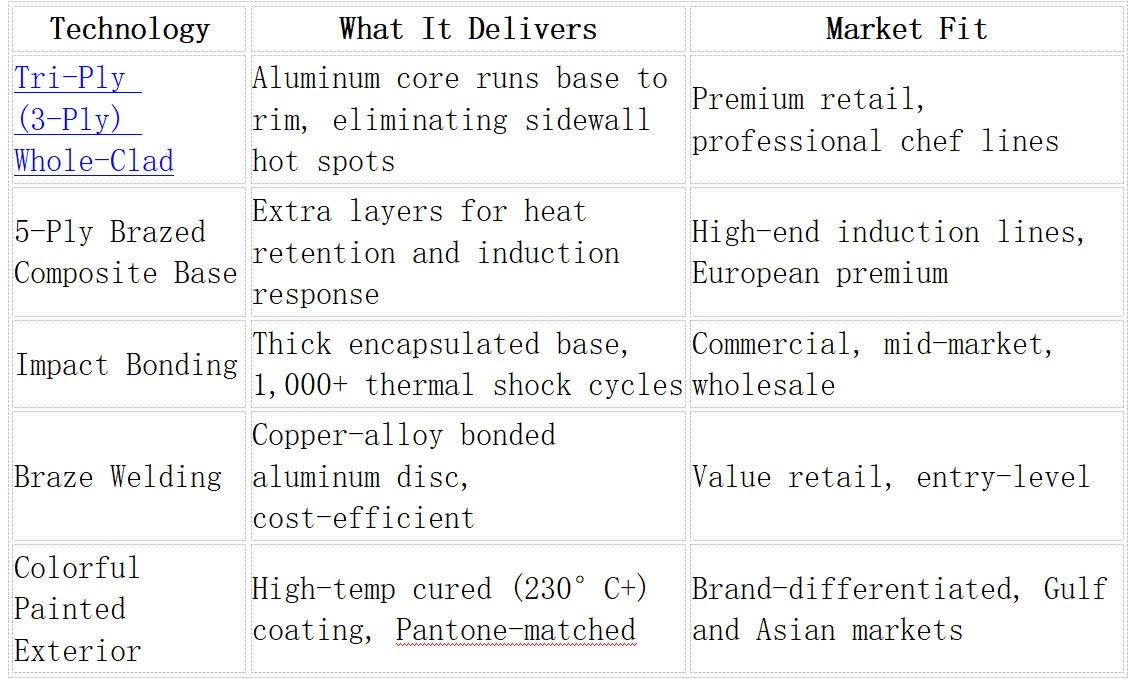
Five base technologies in-house. Most factories specialize in one or two construction methods, so their recommendations reflect what’s on their floor rather than what suits your market. JC Cookware runs all five:
Certifications: ISO 9001:2015, BSCI, CE Marking, LFGB (stricter than FDA), and FDA compliance, backed by in-house XRF spectrometer testing and batch-level material test reports on every order.
OEM/ODM path. New buyers typically start with ODM (500–1,000 units/SKU, 4–6 weeks) using JC Cookware’s existing designs, then move proven SKUs to full OEM (custom molds at $3,000–$8,000 each, MOQs 1,000–3,000 units/SKU) once demand is validated. In-house R&D handles CAD, mold fabrication, and pre-production sampling to reduce revision cycles.
Specialty lines: Nesting/Matryoshka sets (Model JC-9010A) fold their handles and lid knobs so each pot nests inside the next, shrinking packaging footprint by 40–60% — lower freight costs and strong appeal in space-constrained urban kitchens. Colorful Painted Exteriors (Models JC-8110B, JC-8210A) offer cobalt blue, matte black, gold, copper, and burgundy finishes that resist oxidation, wipe clean easily, and perform well in Gulf markets where cookware is displayed openly. Both categories have minimal existing B2B content online.
Key figures: Founded 2003 · 40,000 m² facility · 3,000,000+ pieces/year · 50,000,000+ units exported · 30+ markets · ODM MOQ 500–1,000/SKU · OEM MOQ 1,000–3,000/SKU · standard lead time 30–45 days. More detail at https://jincui.com/.
304 (18/8) is the industry standard: chromium forms the passive oxide layer preventing rust; nickel adds corrosion resistance and shine. 316 adds molybdenum for superior resistance to chloride corrosion — worth the premium for coastal or marine-adjacent markets. 201 replaces nickel with manganese to cut cost, rusts and pits over time, and is routinely misrepresented as 304 since the two look identical.
18/8 vs. 18/10: both are 304 steel; 18/10 just sits at the upper end of the nickel range. It’s a marketing label, not a different material — don’t pay a premium for it.
Verifying authenticity, ranked by accuracy: (1) XRF spectrometer testing — reads composition in under 30 seconds; a factory without one, or unwilling to let you test on-site, is a red flag. (2) Third-party lab test reports — mill test certificates verified independently by SGS or Intertek ($50–150/sample). (3) Chemical reagent test — a quick molybdenum-detection field test that distinguishes 304 from 201 for under $5.
JC Cookware runs XRF testing on every incoming steel batch and maintains full material traceability, with batch-level test reports issued on every order.
Base Construction: Three Technologies Compared
Whole-Clad (Tri-Ply / Multi-Ply Clad): three bonded layers — 304 stainless interior, aluminum core, magnetic 430 stainless exterior — extending from base to sidewalls. Reduces hot spots by up to 60% versus single-ply, at a higher cost that positions it as mid-to-premium. Representative model: JC-8020A.
Impact Bonding (Encapsulated Base): high-pressure friction fuses an aluminum disc to a single-ply stainless body. Excellent heat distribution at lower cost than whole-clad, withstanding 1,000+ thermal shock cycles — the preferred choice for wholesale, mid-market buyers. Sidewalls remain single-ply, so heating up the sides is less even than whole-clad. Representative model: JC-8410A.
Brazing Base: an aluminum disc joined via copper-based brazing alloy — the oldest, lowest-cost method, reliable for standard home cooking but prone to delamination under thermal shock; not recommended for commercial use. Representative model: JC-8080A.
Match the technology to the target market — don’t sell brazed-base pans as premium, and don’t over-invest in whole-clad for a value channel.
Specialty Product Lines
Nesting/Matryoshka Sets: foldable handles and collapsible lid knobs let each pot nest inside the next, compressing a six-piece set into roughly the space of one stockpot. Benefits: 40–60% less package volume, lower ocean-freight and last-mile costs, and genuine appeal in small European and Asian apartments. Representative model: JC-9010A — first-mover advantage since little competing B2B content exists for this category.
Colorful Painted Exterior: high-temperature paint (230°C+ cure) in cobalt blue, matte black, gold, copper, and burgundy, Pantone-matchable for OEM programs. Beyond aesthetics, the coating resists oxidation and wipes clean easily — a strong fit for Gulf markets where cookware is displayed rather than stored. Representative models: JC-8110B and JC-8210A.
OEM vs. ODM: Choosing the Right Partnership
OEM — you supply the design; the factory builds to spec and you own the molds. Best when you have an established brand, in-house design capability, and can absorb higher MOQs (1,000–3,000 units/SKU) plus tooling costs ($3,000–$8,000/mold).
ODM — you brand an existing factory design. Best for fast market entry, lower MOQs (500–1,000 units), and demand-testing before committing to custom tooling. ODM catalog products are shared with other buyers, though exclusive colors or handle designs can differentiate.
Many brands start with ODM to validate demand, then transition best-sellers to OEM.
How to Evaluate a Supplier: Factory Scorecard
Verification checklist: registered manufacturing business license (not a trading company); proof of factory ownership or lease; monthly production capacity and utilization; in-house capability across drawing, bonding, polishing, and assembly; ISO 9001 or equivalent QMS; testing equipment (XRF spectrometer, thermal distribution tester, salt spray tester); dedicated R&D team.
Ten must-ask questions: steel grades stocked and incoming material test reports; which base construction technologies are done in-house; MOQ per SKU for standard vs. OEM products; whether you can visit the floor during your production run; third-party inspection options; certifications held (CE, LFGB, FDA, ISO); 12-month defect rate; references in your target market; standard lead time to FOB; and the claims process for quality disputes. Evasive answers are a warning sign.
Sample protocol: initial sample (design, finish, basic function) → pre-production “golden sample” made on the actual mass-production line → small-batch trial shipment (20–30% of order), inspected before releasing the remaining 70–80%.
Common Sourcing Pitfalls
A 2023 case: a European housewares brand sourced cookware priced 25% below market from a new supplier. Samples were genuine 304; production quietly switched to 201. Rust and pitting followed within six months, costing €40,000 in recalls and a three-year retail relationship.
Pitfall 1 — 201 passed off as 304: the most damaging fraud in this category. Demand XRF testing on production-floor material, add grade-verification penalty clauses to contracts, and treat unusually low pricing as a red flag.
Pitfall 2 — trading companies posing as factories: many “manufacturers” on B2B platforms are middlemen marking up prices 15–30%. Request a factory visit or live video walkthrough; check that the business license lists manufacturing as its registered scope.
Pitfall 3 — sample quality ≠ production quality: require pre-production samples made on the actual line, use the small-batch trial protocol, and add a “golden sample” clause requiring production to match approved samples within defined tolerances.
Pitfall 4 — ignoring MOQ until too late: ask about MOQ in your first conversation, negotiate it separately from price, and look for ODM programs or trial orders (500–1,000 units).
Market-Specific Considerations
United States: FDA food-contact compliance (test reports from SGS/Intertek); induction compatibility increasingly expected; large-format retail favors aggressive pricing while premium DTC brands favor whole-clad.
European Union: CE marking mandatory; LFGB compliance effectively required for pan-European distribution; sustainability storytelling and PFAS-driven demand for stainless steel are competitive advantages.
Middle East: a Gulf-region procurement manager doubled sales within a quarter after switching to larger pot capacities, heavier-gauge bases for sustained high-heat cooking, and bold exterior colors. Key considerations: stock pots of 8–12Qt and sauté pans 30cm+; impact-bonded or whole-clad construction (brazing not recommended); bold warm tones (gold, copper, burgundy); growing relevance of Halal compliance; SASO/ESMA/GCC conformity certifications; and production timed ahead of Ramadan demand spikes.
Frequently Asked Questions
What is the best stainless steel grade for cookware? 304 (18/8) is the minimum standard for food-contact cookware; 316 adds molybdenum for coastal and premium markets; 201 is unsuitable for food contact.
How do I verify a manufacturer’s steel quality? Use XRF spectrometer testing on the production floor, request third-party lab reports from SGS or Intertek, and use chemical reagent tests to distinguish 304 from 201.
What certifications does stainless steel cookware need? CE and LFGB for the EU; FDA food-contact compliance with test reports for the US; SASO, ESMA, and CE acceptance for Middle East markets; ISO 9001 is recommended globally.
Conclusion: Your Next Step
What separates a worthwhile manufacturer is consistent quality six orders from now, adaptability as your market shifts, and the ability to scale with a bestseller. Verify steel grades with XRF rather than trust labels. Match base construction to your market — whole-clad for premium, impact-bonded for mid-market, brazed for value. Consider specialty lines: nesting sets cut freight and storage costs, colorful exteriors expand consumer choice, and neither category is crowded online yet. Run the scorecard — factory verification, the ten questions, and the sample protocol — to eliminate most sourcing risk. And remember that requirements vary sharply by market: Munich isn’t Dubai.
If you’re looking for a partner with CE, LFGB, and FDA certifications, five base construction technologies under one roof, and a track record of 50 million+ units shipped to 30+ countries, JC Cookware is ready to talk. Visit https://jincui.com/ to start a conversation.
Jiangmen Xinhui Jincui Metalware Co., Ltd.
Jiangmen Xinhui Jincui Metalware Co., Ltd.
+ +86 18948964886
email us here
Visit us on social media:
LinkedIn
Facebook
YouTube
X
Legal Disclaimer:
EIN Presswire provides this news content “as is” without warranty of any kind. We do not accept any responsibility or liability
for the accuracy, content, images, videos, licenses, completeness, legality, or reliability of the information contained in this
article. If you have any complaints or copyright issues related to this article, kindly contact the author above.

Media gallery