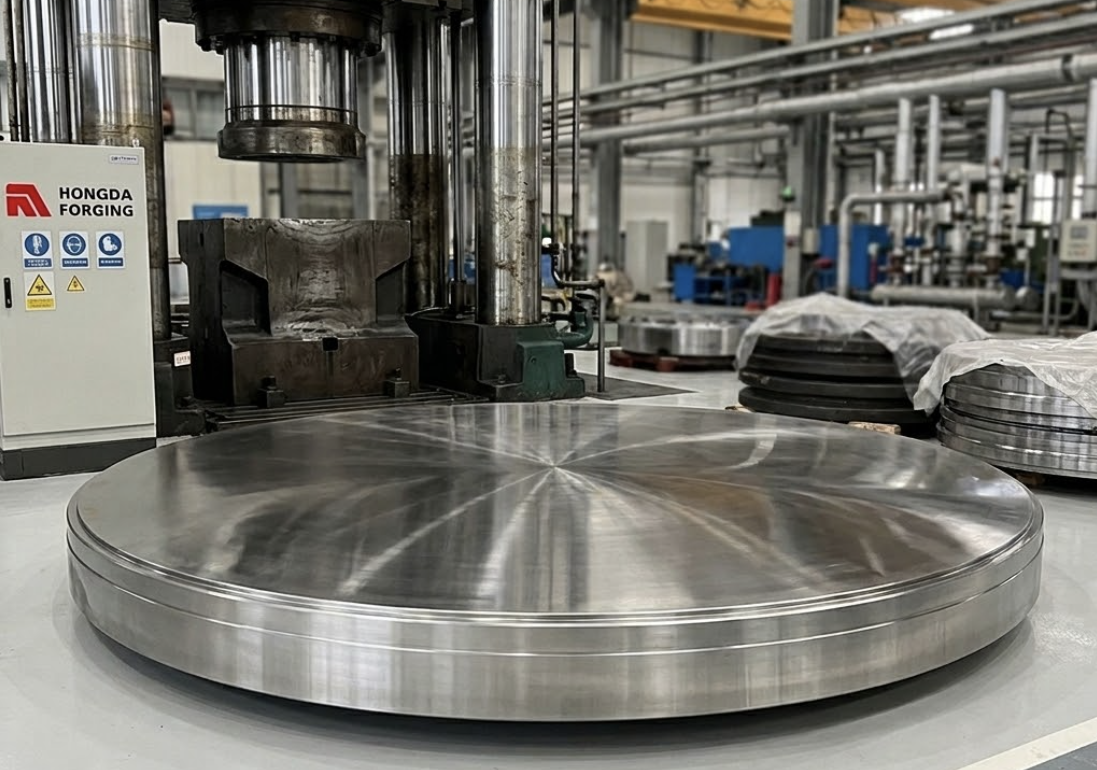
WUXI, JIANGSU, CHINA, October 11, 2026 /EINPresswire.com/ — The global industrial landscape experiences steady growth as chemical processing plants expand their infrastructure. Petrochemical, refining, and nuclear energy sectors continuously scale up their loop reactor capacities to optimize thermal efficiency. These high-capacity configurations require highly dependable pressure containment systems to ensure operational safety. At the critical junction of these thermal exchange units sits the heavy forged tube sheet. This component must act as an unyielding mechanical boundary between different fluid channels. Consequently, engineering procurement specialists seek manufacturing partners with verified technical credentials. To satisfy this critical market demand, the manufacturer presents its advanced metallurgical solutions to international buyers. The industrial enterprise operates as a highly proficient Certified 16Mn Forged Tube Sheet For Pressure Reaction Vessel Supplier for critical energy networks. This focused dedication provides downstream industrial systems with predictable safety margins during continuous high-pressure operations. Modern engineering operations rely heavily on these certified components to maintain environmental and structural protection. Investing in verified pressure boundaries reduces long-term operational hazards across international industrial zones.
The Seal Integrity Imperative: Preventing Micro-Leakage Under Cyclic Thermal-Mechanical Stresses
Industrial loop reactors and multi-tubular pressure vessels operate under incredibly punitive mechanical conditions. These systems handle hazardous chemical substances at elevated pressures and severe operating temperatures. During daily production cycles, the internal environments subject components to rapid thermal fluctuations and immense structural loads. The forged tube sheet bears the primary burden of isolating the shell-side medium from the tube-side medium. Therefore, maintaining a perfect hermetic seal remains the absolute priority for plant operators. Even a minor localized leak can cause catastrophic cross-contamination or toxic atmospheric releases. Such containment failures result in expensive emergency shutdowns and severe regulatory penalties for the operating firm. To resist these dynamic forces, engineering designs demand advanced structural materials. Manufacturers utilize specialized 16Mn carbon-manganese steel due to its exceptional baseline yield strength and pressure resistance. Additionally, for highly corrosive chemical streams, facilities deploy high-grade 30408 austenitic stainless steel variants. These robust material choices provide the necessary molecular stability to withstand long-term mechanical degradation. Consequently, choosing high-integrity metal substrates forms the first defense line against long-term fatigue. Stable pressure containment safeguards both human capital and multi-million dollar capital investments.
Defeating Post-Drilling Distortion: Optimizing Forging Reduction Ratios for Perforated Matrix Stability
Fabricating a high-performance tube sheet requires drilling thousands of high-precision holes across the metal face. This dense perforated matrix accommodates the heat exchanger tubes that carry processing fluids. However, this intensive drilling process removes a significant volume of metal, which relaxes inherent residual stresses. If the raw forged block possesses internal structural imbalances, the component will warp or distort during machining. This geometric instability ruins the tight dimensional tolerances required for automated orbital tube welding. To defeat this persistent manufacturing hurdle, WUXI HONGDA HEAVY INDUSTRY CO., LTD implements a rigorous heavy forging protocol. The production technicians enforce a high forging reduction ratio during the initial hot working phase. This deep compression thoroughly breaks down the coarse as-cast dendritic grain formations inside the raw steel ingot. Consequently, the metal matrix achieves total structural densification and uniform grain refinement. The resulting forged plate exhibits isotropic dimensional soundness throughout its entire volume. When clients execute complex multi-spindle drilling operations, the tube sheet remains perfectly flat and structurally stable. This geometric reliability ensures flawless tube insertion, simplifies downstream assembly procedures, and lowers manufacturing defect rates significantly.
The ASME and PED Validation Framework: Standardizing the Total Life-Cycle Quality Chain
Navigating the international energy market requires strict compliance with diverse transnational regulatory frameworks. For pressure vessel components, the American Society of Mechanical Engineers (ASME Section VIII) codes represent the absolute global benchmark. Concurrently, European markets mandate strict adherence to the Pressure Equipment Directive, commonly known as PED 2014/68/EU protocols. International engineering firms do not accept unverified material claims for high-stakes installations. Therefore, HONGDA HEAVY INDUSTRY (WUXI HONGDA HEAVY INDUSTRY CO., LTD) integrates these dual regulatory mandates into its core manufacturing workflow. The quality assurance team manages a traceable validation framework that tracks every steel ingot from the initial melt. Chemists perform exact ladle analysis to verify that phosphorus, sulfur, and trace elements remain within ultra-low boundaries. This clean chemistry directly enhances the material’s resistance to hydrogen-induced cracking and low-temperature impact brittleness. The manufacturing firm backs these rigorous protocols with a comprehensive portfolio of official international certificates. These verified credentials allow every delivery to pass through customs and regulatory inspections seamlessly, saving valuable project time. Maintaining uncompromised compliance helps international energy operators secure necessary insurance approvals without delays.
Eliminating Residual Stress Gradients: Advanced Thermal Processing and Non-Destructive Testing (NDT)
Applying massive hydraulic forces during heavy forging operations inevitably introduces internal residual stress gradients. If engineers leave these stresses unaddressed, the material will exhibit unpredictable mechanical behavior under cyclic operating pressures. To eliminate these hidden risks, the facility subjects every forged tube sheet to advanced heat treatment regimes. Precise normalizing and tempering cycles completely discharge the internal stress concentrations accumulated during pressing. This controlled thermal processing optimizes the microstructure, producing a balanced combination of tensile strength and impact toughness. Furthermore, this uniform grain structure significantly enhances the weldability of the 16Mn and 30408 substrates. When technicians perform automated orbital welding to attach tubes to the sheet face, the heat-affected zone resists cracking. After completing the thermal cycles, the quality control department initiates extensive non-destructive evaluation procedures. Inspectors perform multi-directional ultrasonic testing to scan the entire internal volume for microscopic voids or inclusions. Additionally, liquid penetrant testing checks the machined faces for surface imperfections. This exhaustive testing sequence guarantees that the highly stressed ligament areas between tube holes are completely defect-free and secure.
Securing High-Stakes Energy Infrastructure: Wuxi Hongda as a Global Pressure Vessel Sourcing Anchor
The modern petrochemical and power generation industries require absolute predictability from their manufacturing supply chains. Standard commodity forgings often fail to meet the stringent longevity targets specified by modern engineering procurement firms. HONGDA HEAVY INDUSTRY resolves this industry challenge by delivering highly customized, precision-engineered pressure vessel components. The enterprise blends heavy industrial asset capacity with sophisticated metallurgical science to protect global energy assets. By supplying structurally superior 16Mn and stainless steel tube sheets, the firm helps operators minimize maintenance overheads. This consistent manufacturing excellence reinforces the reputation of high-end industrial engineering on the global stage. Procurement directors, mechanical engineers, and pressure vessel fabricators can confidently rely on this stable manufacturing infrastructure. Engaging with specialized engineering teams early in the design phase optimizes material utilization and shortens project delivery schedules. This proactive technical collaboration eliminates costly modifications during later construction phases. To review detailed product specifications, industrial equipment listings, and traceable compliance documentation, please visit the official corporate portal at https://www.hongdaforge.com/.
HONGDA HEAVY INDUSTRY
HONGDA HEAVY INDUSTRY
Legal Disclaimer:
EIN Presswire provides this news content “as is” without warranty of any kind. We do not accept any responsibility or liability
for the accuracy, content, images, videos, licenses, completeness, legality, or reliability of the information contained in this
article. If you have any complaints or copyright issues related to this article, kindly contact the author above.

Media gallery