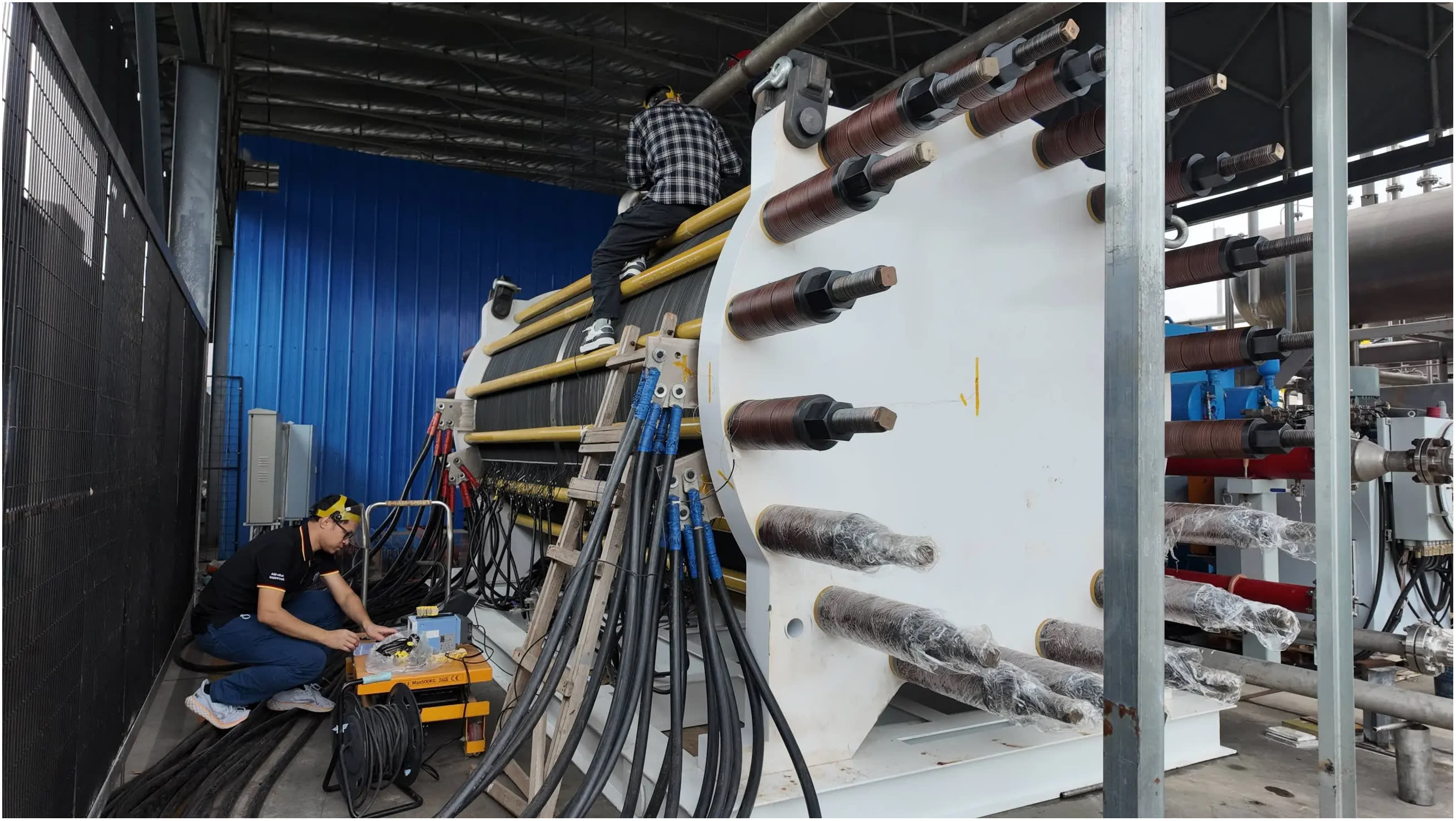
CHENGDU, SICHUAN, CHINA, November 3, 2026 /EINPresswire.com/ — Evaluating an industrial Alkaline Electrolyser Manufacturer requires examining complete equipment balance beyond the core cell stack. Commercial hydrogen production depends on the synchronized operation of gas-liquid separation, catalytic purification, regulated power conversion and electrolyte circulation. When plant developers evaluate equipment options, stack efficiency alone cannot guarantee operational continuity or product compliance. As an established alkaline electrolyser manufacturer, Houpu designs pressurized alkaline hydrogen production equipment to deliver stable output, precise process control and low lifecycle maintenance for global clean-energy infrastructure.
The Five Functional Units in Houpu’s Alkaline Hydrogen System
Electrolysis unit
The electrolysis unit serves as the primary electrochemical conversion stage within the production facility. Regulated direct current energizes bipolar cell stacks, splitting demineralized water into gaseous hydrogen and oxygen across porous composite diaphragms. Precision-machined cell frames, high-conductivity bipolar plates and specialized catalytic electrode coatings deliver elevated current efficiency across decades of continuous industrial duty.
Proper cell stack sizing directly reflects the required volumetric hydrogen output and anticipated plant operating profiles. Houpu designs its cell assemblies to sustain mechanical stability under differential pressures while maintaining uniform electrolyte distribution across every individual cell chamber.
Separation unit
Effluent from the electrolyzer stack emerges as a vigorous two-phase mixture of product gases and circulating potassium hydroxide electrolyte. The separation unit incorporates dedicated gas-liquid separators for the hydrogen and oxygen streams, preventing gas crossover and protecting downstream equipment. These vertical pressure vessels disengage entrained liquid, cool crude product gases and return concentrated electrolyte to the common circulation manifold.
Automated liquid-level transmitters and differential pressure control loops maintain steady gas-liquid interfaces inside the separator vessels. Reliable separation stabilizes process conditions before product gases enter final purification stages, safeguarding circulating pumps from vapor cavitation.
Purification unit
Raw hydrogen leaving the separation unit contains trace oxygen and saturated water vapor that must be removed for fuel-cell or industrial applications. The hydrogen purification unit utilizes catalytic deoxidation followed by dual-tower regenerative adsorption drying. In the deoxidation reactor, precious-metal catalysts react residual oxygen with hydrogen to form water vapor, lowering oxygen content to negligible parts-per-million levels.
Dual desiccant towers operate on an alternating cycle, utilizing temperature-swing adsorption to remove moisture down to stringent dew point thresholds. This multi-stage treatment elevates product gas purity from 99.8% before purification up to 99.999% at battery limit, delivering high-purity hydrogen with minimal regeneration gas loss.
Power supply unit
The power supply unit converts incoming grid or renewable alternating current into high-amperage, regulated direct current for the cell stack. Utilizing heavy-duty step-down transformers coupled with thyristor or IGBT rectifiers, the system matches power input to the electrolyzer’s dynamic operating curve. Low ripple factors and active harmonic suppression safeguard cell electrodes from premature degradation.
Integrated digital control architecture links the rectifier output with plant automation networks. This coordinated control permits rapid current modulation while protecting electrical transformers against thermal overload during fluctuating grid or renewable power delivery.
Alkali circulation unit
Continuous electrolyte circulation sustains uniform chemical concentration and thermal equilibrium throughout the bipolar cell stack. The alkali circulation unit integrates caustic mixing tanks, corrosion-resistant canned motor pumps, plate heat exchangers and fine particulate filters into a closed fluid circuit. Circulating potassium hydroxide solution removes excess heat while supplying reactants to active cell surfaces.
Precision temperature regulation loops maintain the circulating electrolyte at the design baseline of 85±5°C. Automated flow balancing and accessible sampling ports enable operators to inspect solution chemistry and maintain pump seals without interrupting continuous hydrogen generation.
Split and Integrated Equipment Serve Different Deployment Models
Deployment architecture determines civil foundation requirements, transport logistics and field installation schedules. Houpu provides two standardized configurations tailored to distinct commercial production scales: split systems and integrated skid-mounted packages.
Split alkaline hydrogen production systems are engineered for large-scale centralized chemical plants and industrial hubs. In a split layout, cell stacks, separation skids, purification columns and electrical rectifiers occupy dedicated process bays. This separation provides generous overhead crane clearance for major stack maintenance, isolates hazardous process zones and accommodates phased multi-train expansion as facility demand grows.
Integrated skid-mounted systems assemble cell stacks, gas separation vessels, catalytic purification towers and electrical switchgear onto unified steel frames. This pre-packaged configuration suits decentralized vehicle refueling stations, industrial pilot facilities and commercial testing installations. Shop pre-assembly minimizes on-site welding, reduces civil foundation requirements and accelerates destination commissioning.
The FT-Series Operating Envelope
Houpu’s standardized FT-series encompasses hydrogen production capacities spanning 100 to 1,500 Nm³/h per production train. Sizing equipment within this established envelope allows plant designers to configure single-train or multi-train installations with predictable balance-of-plant footprints.
The published technical baseline specifies an adjustable operating pressure of 1.6 MPa. This intermediate pressure strikes an optimal engineering balance, minimizing vessel wall thicknesses in large-capacity stacks while reducing the required compression stages for downstream vehicle fueling or pipeline injection. The operating thermal window is maintained at 85±5°C, ensuring high electrochemical activity without accelerating alkaline corrosion.
Gas purity benchmarks deliver 99.8% hydrogen prior to purification and 99.999% following catalytic deoxidation and adsorption drying, while byproduct oxygen purity achieves at least 98.5%. Single-vessel electrical power tracking modulates from 25% up to full 100% load, allowing the system to follow fluctuating renewable power inputs smoothly.
Operational flexibility is reinforced by rapid startup capabilities: starting from ambient cold conditions requires 30 minutes to achieve full output, while warm restarts execute within 10 seconds under maintained thermal standby. System structural integrity supports a 25-year design lifespan with major overhaul intervals scheduled every 10 years.
From Nameplate Capacity to a Maintainable Production Train
Translating nominal electrolyzer capacity into a dependable commercial plant requires sizing auxiliary process systems to handle dynamic gas and fluid flows. Gas-liquid separators and catalytic purification towers must be engineered around peak volumetric generation rather than average hourly ratings.
Electrical rectifiers and step-down transformers require adequate thermal sizing to handle continuous full-power duty without derating. Alkali circulation loops demand dual-redundant circulating pumps and generously sized plate heat exchangers to manage thermal dissipation across shifting seasonal ambient temperatures.
Process instrumentation must incorporate multi-variable transmitters, automated pressure balancing valves and continuous gas-purity monitoring taps along main discharge headers. Downstream interfaces with multi-stage booster compressors, buffer storage cylinders or pipeline tie-ins require coordinated pressure regulation to prevent hydraulic shock during sudden plant shutdowns.
Plant layout must provide ample physical clearance for routine inspection, component isolation and scheduled maintenance. Generous spacing around pump skids, accessible valve manifolds and designated overhead rigging corridors ensure that technician teams can service filters, valves and instruments safely without dismantling adjacent equipment.
Project Integration Beyond the Production Package
Equipment value increases substantially when the manufacturer engineers complete interfaces rather than supplying isolated process machinery. Real-world commercial facilities require tight coordination between hydrogen generation, gas treatment, cascade storage and dispensing.
Tangible evidence of interface engineering is demonstrated at the Hanlan hydrogen production and refueling mother station. In that contract, Houpu delivered the complete process package, linking pressurized alkaline water electrolysis, catalytic deoxidation and drying skids with high-pressure storage banks and dual-pressure vehicle dispensers.
The Hanlan installation successfully integrates on-site generation at 1.6 MPa with downstream compression and both 35 MPa and 70 MPa dispensing islands. Coordinating pressure cascades and emergency shutdown logic under a unified control architecture proved that single-source interface engineering eliminates field communication mismatches and shortens commissioning timelines.
What Buyers Should Expect from a Complete Manufacturer Scope
Procurement teams evaluating alkaline electrolyzer manufacturers should mandate comprehensive engineering documentation and clear battery-limit definitions. A complete scope includes detailed piping and instrumentation diagrams, functional safety logic narratives, electrical single-line diagrams, factory acceptance test protocols and site commissioning procedures.
Contractual clarity regarding spare parts availability, preventive maintenance schedules and long-term technical support ensures sustained facility availability. Buyers should verify that the manufacturer provides qualified field engineers to supervise mechanical positioning, hydrostatic testing, nitrogen purging and initial gas startup.
Houpu supports global clean-energy developers with an engineering cadre exceeding 100 dedicated technical specialists. The company holds 494 approved patents, 124 software copyrights, 60 explosion-proof qualification certificates and 138 European CE marks, having contributed to drafting 21 national standards and 7 regional technical specifications. This institutional foundation ensures that manufactured equipment satisfies rigorous international mechanical, electrical and safety mandates.
Integrated Functional Architecture: Delivering Reliable Alkaline Electrolyzer Performance
Houpu’s standardized alkaline hydrogen production architecture—integrating electrolysis, separation, purification, power supply and alkali circulation—provides global project developers with dependable, high-purity hydrogen generation equipment. As a dedicated alkaline electrolyser manufacturer, Houpu ensures that each functional block operates with high durability and thermodynamic coherence. Project developers seeking qualified equipment integration and manufacturing specifications can explore complete technical portfolios at https://www.hqhp-en.com/.
Houpu
Houpu
Legal Disclaimer:
EIN Presswire provides this news content “as is” without warranty of any kind. We do not accept any responsibility or liability
for the accuracy, content, images, videos, licenses, completeness, legality, or reliability of the information contained in this
article. If you have any complaints or copyright issues related to this article, kindly contact the author above.

Media gallery